The Iran war and the collapse of US empire
Greetings patrons,
It’s time for another research update. In this letter, two things:
- (Not) testing the labor theory of value
- The Iran war and the collapse of US empire
(Not) testing the labor theory of value
At its root, economics is filled with a set of core theories that are untestable. Marxist economics is one of the main offenders.
Now, unless you’ve spent time in a grad-school social-science department, you’ve probably never encountered an academic Marxist. But I assure you that they exist, and that they produce silly things. Academic Marxists have built a towering edifice of theory on the back of Marx’s labor theory of value. Everything they say hinges on the idea that workers produce all value, and that capitalists take an unearned cut by exploiting workers.
For the most part, Marxists are content to simply assume that the labor theory of value is true. But a smaller group of thinkers try to maintain the façade of science by offering supposed ’tests’ of this untestable theory. With this empirical silliness in mind, the Review of Capital as Power has recently published two papers that deconstruct how Marxists (claim to) test the labor theory of value. The first paper is by Isabella K Sabatino:
- Humbug Labor Values (winner of the 2026 Capital as Power essay prize)
Sabatino shows that attempts to ’test’ the labor theory of value (using the national accounts) seem to work regardless of the data they are fed. To demonstrate this fact, Sabatino ‘validates’ the labor theory of value with input data that spells the word ‘HUMBUG’.
The second paper is by me, and expands on Sabatino’s work. I argue that Marxists ’test’ the labor theory of value simply by imposing their metaphysical principles onto otherwise banal bookkeeping data:
Both essays are fairly technical, but hopefully they will convince more folks that the Marxist clergy spout nonsense.
The Iran war and the collapse of US empire
On to more pressing matters. We’re now a month into the Iran War, which is turning out to be a seminal moment in the decline of US empire. To make sense of the ongoing US failure to subjugate Iran, we need to understand the decline of US hegemony. Here are three ways to do so.
Let’s start with US industrial power. To be a global military power, a country must make the technology that backs its military might. US military planners are now learning this lesson the hard way. Take the recent destruction of Gulf-based radar detectors. These devices require large amounts of gallium to be built. And who controls the production of gallium? That would be China, which commands 98% of the worlds gallium supply. Given this choke hold, it seems likely that these radar detectors will never be rebuilt.
In more general terms, US industrial supremacy has long been fading. Measured in terms of the share of world energy consumption, US industrial might peaked in the 1950s, and has been ebbing ever since.

Now, if a country is industrially dominant, it can also be a major military power. Here, it is clear that the US military is the most powerful imperial force ever created. That said, the US military is now a shadow of its former self.
Again, it is energy consumption that tells the story. Although the US military consumes profligate amounts of energy, the relative scale of this consumption is far smaller than it once was. As the chart below shows, when we measure the US military’s share of world energy consumption, we find that it has declined more than fivefold over the last fifty years. The message, then, is that the hard power of the US military — its ability to dominate the world through sheer technological force — is in steep decline.

And that brings me to the last form of hegemony, which is the use of soft military power to project dominance. By ‘soft military power’, I mean that the mere presence of the US military is often enough to deter rivals. In other words, the US does not control global seaways by engaging in constant warfare with would-be usurpers. Instead, the US plants its military across the globe, and this threat of force is enough to assert dominance.
Of course, the use of soft military power only works if the threat of overwhelming force is credible. Here, US hawks have cleverly masked the decline of American military power by only going to war with vastly weaker opponents (for example, in Afghanistan, Iraq, Syria, and Yemen). And so, although the hard power of the US military is a shadow of its former self, the global network of US military bases has remained largely unchanged since the Cold War ended.
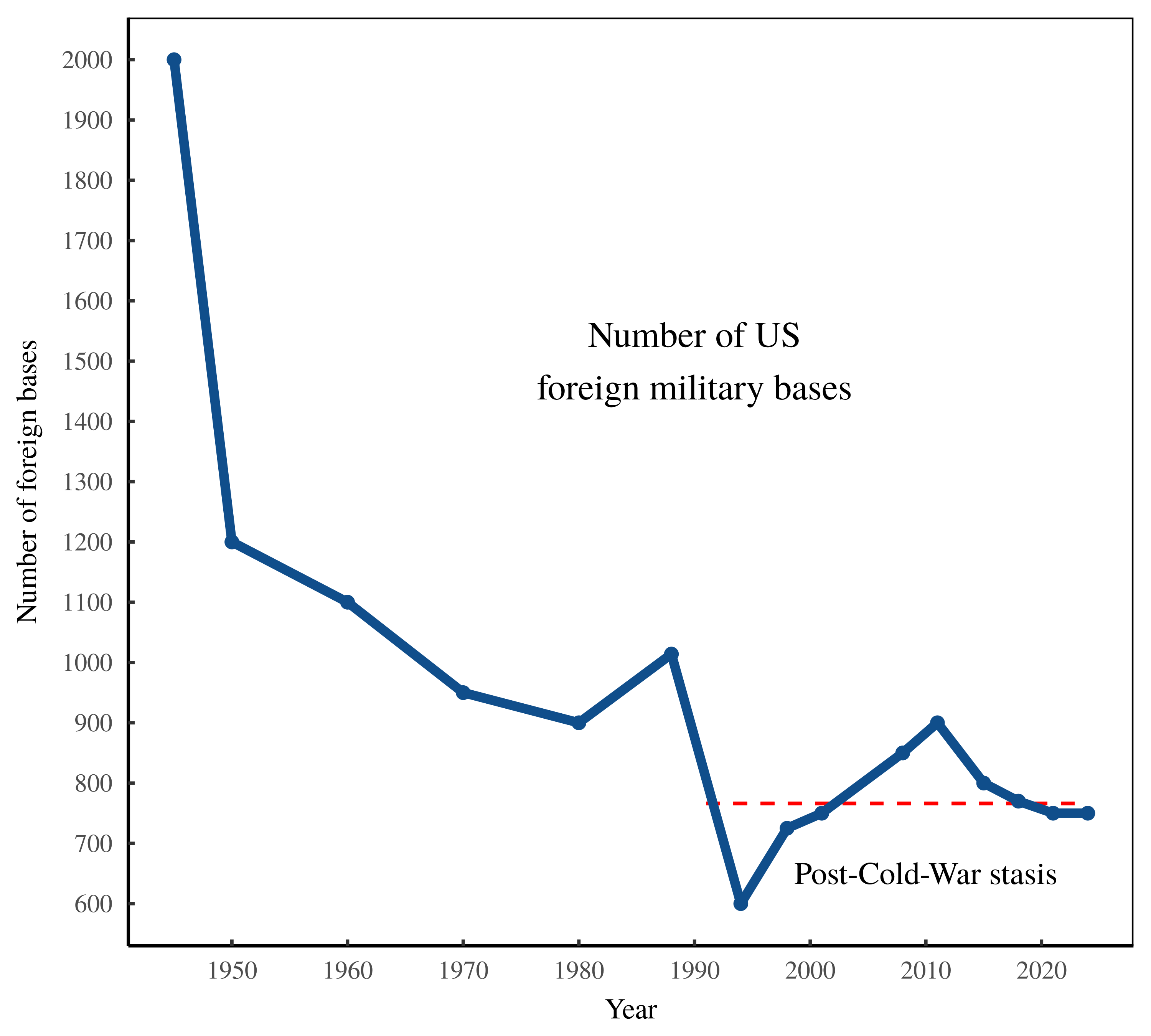
Today, the Iran war has blown a hole in US soft military power. Not only has the US military proved incapable of keeping critical trade routes open, it has proved incapable of defending its own bases. (To date, Iran has destroyed 13 US military bases in the Middle East.) Indeed, the gulf states are now discovering that the presence of the US military is a liability, not a deterrent. No doubt every country with a US military base is now rethinking its strategy.
What’s clear from this debacle is that the Pax Americana is dead. The US military is no longer the world’s police force (to the extent that it ever was); it is a militia that operates for the benefit of Israeli fascists, and for the krepto-class in Washington. The US imperial retreat has begun. The main question is how much violence the world must endure before the Pax Sinica prevails.
Until next time
Well, that’s it for this update. As always, thanks for your support. Let’s hope that the US empire can fall without taking the rest of the world with it!
Best,
Blair