Another DIY summer (in the age of AI)
Greetings patrons,
It’s time for another research update. In this letter, two things:
- Another DIY summer (in the age of AI)
- Exploring the business-to-industry index
Another DIY summer (in the age of AI)
In 2023, my family moved from Toronto to Edmonton, in large part because in Edmonton we could afford to buy a house. Today, we’re the proud owners of a 1948 bungalow located in the heart of Edmonton’s cultural district of Old Strathcona. Overall, the move has been great … but it’s also been a ton of work. For the past three years, I’ve spent each summer doing renovations, which has entailed learning construction skills that a younger Blair thought silly.
Although I’ve come to enjoy these projects (there’s a certain satisfaction that comes from looking at a deck and knowing that you built it), the DIY aspect of our renovations is mostly to save money. In case you haven’t noticed, construction costs have gotten wild.
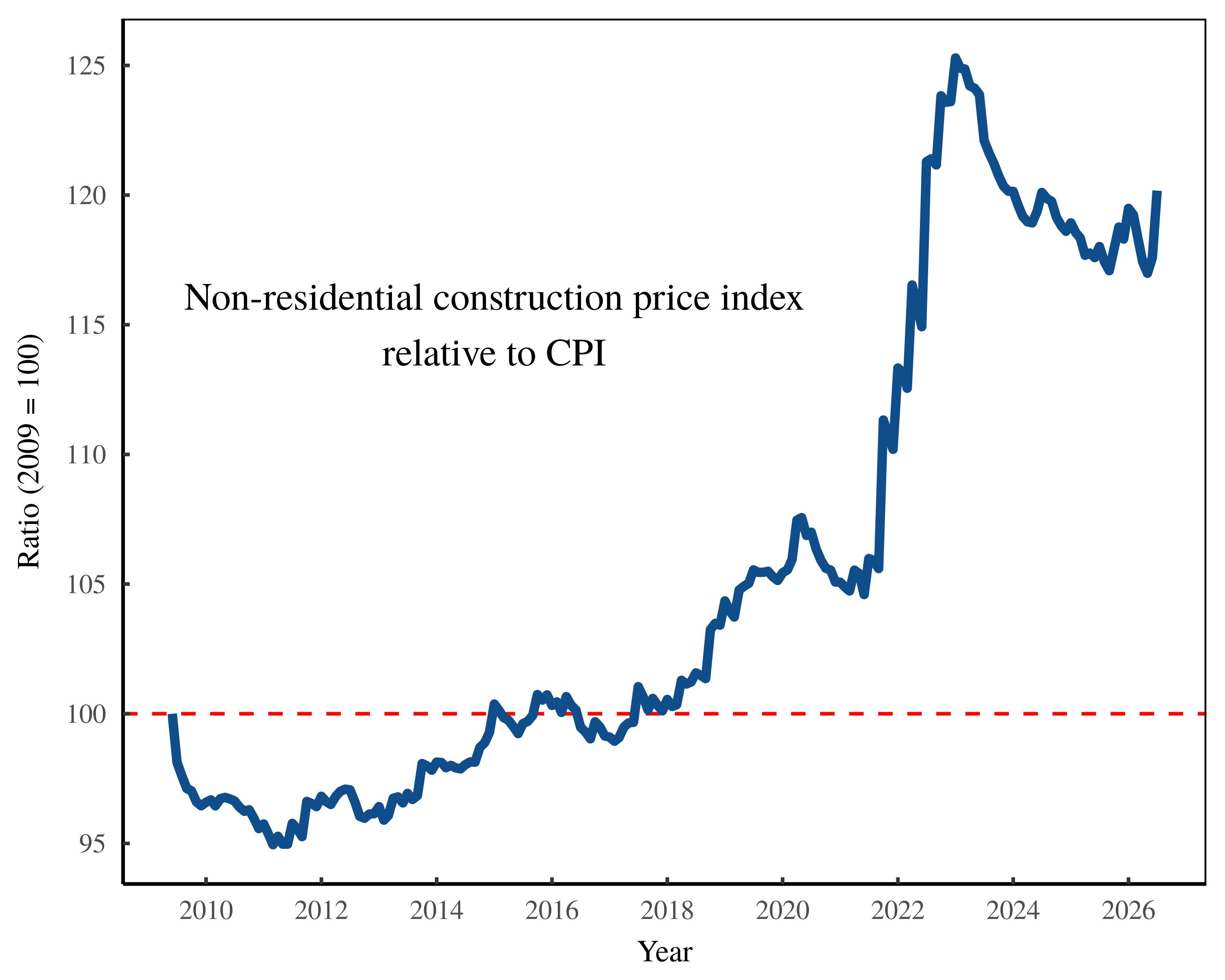
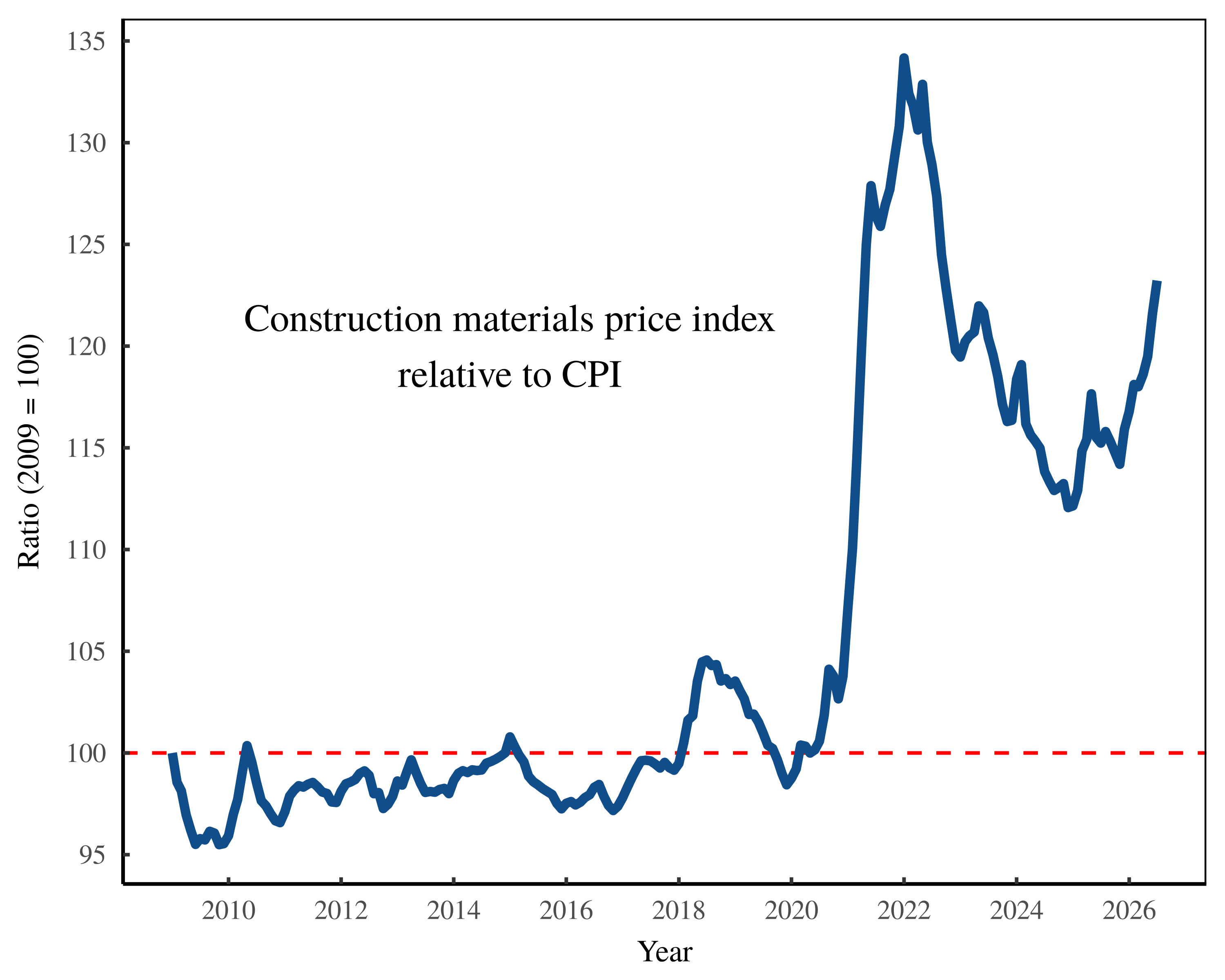
Of course, post-COVID inflation has made everything more expensive. But when it comes to rising construction prices, the standard consumer price index is fairly misleading. Since 2020, construction costs have risen far more than the CPI, as the charts below indicate. (This is US data from FRED.)
On a different note, as I spend each summer doing grueling manual labor, I can’t help reflect on the disconnect between the future that 1950s sci-fi writers envisioned, and the future that we’re living in.
Looking at the first half of the 20th century, 1950s sci-fi writers assumed that machines would continue to replace all forms of manual labor. At the time, it seemed like a good bet. After all, steam shovels had replaced hand-powered digging, machine-driven assembly lines had replaced hand-powered manufacturing, and in the home, an array of new appliances was replacing hand-powered domestic work. If these trends continued, they pointed to the full automation of all forms of manual labor.
Yet this future never came to pass. Why?
Well, a quick look at successful automation shows that it works best when a process can be done repetitively in a single location, allowing the creation of a purpose-built machine that can replace human labor. But what about work that must be done in a variety of places, within environments that vary greatly? Here, sci-fi writes knew that the answer wouldn’t be assembly-line machines; it would be general-purpose robots.
In the 1950s, it seemed easy to imagine that in the 21st century, manual construction would be a thing of the past. Robots would be doing the work for us. This future didn’t happen, in large part because sci-fi writers underestimated how difficult it is to automate the most basic of biological capacities: the ability to autonomously navigate the real world and to manipulate objects within it. As it turns out, it’s far easier to automate (seemingly) ‘precocious’ tasks like writing an essay.
Hence, the future we inhabit. Today, I can ask a chatbot to write a moderately convincing short story based on the themes and styles of a 1950s sci-fi writer. But when I search for a robot that can tile my kitchen floor, it’s nowhere to be found.
So why didn’t 1950s sci-fi writers envision today’s chatbots? Well, a big reason is probably that chatbots have no unambiguous utility. It’s quite obvious that an autonomous construction robot would be useful. But what benefit comes from automating the task of writing and communicating? Well, today we know that the biggest benefits flow to spammers, to students who wish to cheat, and to corporations who want to make their customer service apparatus unusable.
Ultimately, the backbone of all technological revolutions is that they make products and processes more affordable, while maintaining similar levels of quality. But my reading of chatbots is that they’re mostly cheapening social bads. Which is why it’s the dystopian sci-fi writers who’ve been most prescient about the future that’s arrived.
Exploring the business-to-industry index
In other news, Trump is continuing his misanthropic foray in Iran, a war that Cory Doctorow calls the “unscheduled sudden midair disassembly of the American empire”. Despite having the world’s most expensive military, Trump is continually discovering that American military might is not what it once was.
In my last post on the mismeasurement of military power, I invented a metric that I called the ‘business-to-industry’ index. It consists of an entity’s share of world income relative to its share of world energy use. The idea is that the share of world income measures ‘business’ success — the ability to command an income stream. Meanwhile, the share of world energy measures industrial power — the ability to actual manipulate the physical world. Tellingly, the Pentagon’s business-to-industry index is very large, which suggests that the US military operates mostly to make profits rather than to make war.
Looking ahead, my next post will investigate how the business-to-industry index can be used to understand the broader geography of capitalism. The chart below shows a sneak peak of this research. Here, I’ve calculated the business-to-index across all countries in 2023. In particularly, I’ve also divided the US into its constituent states.
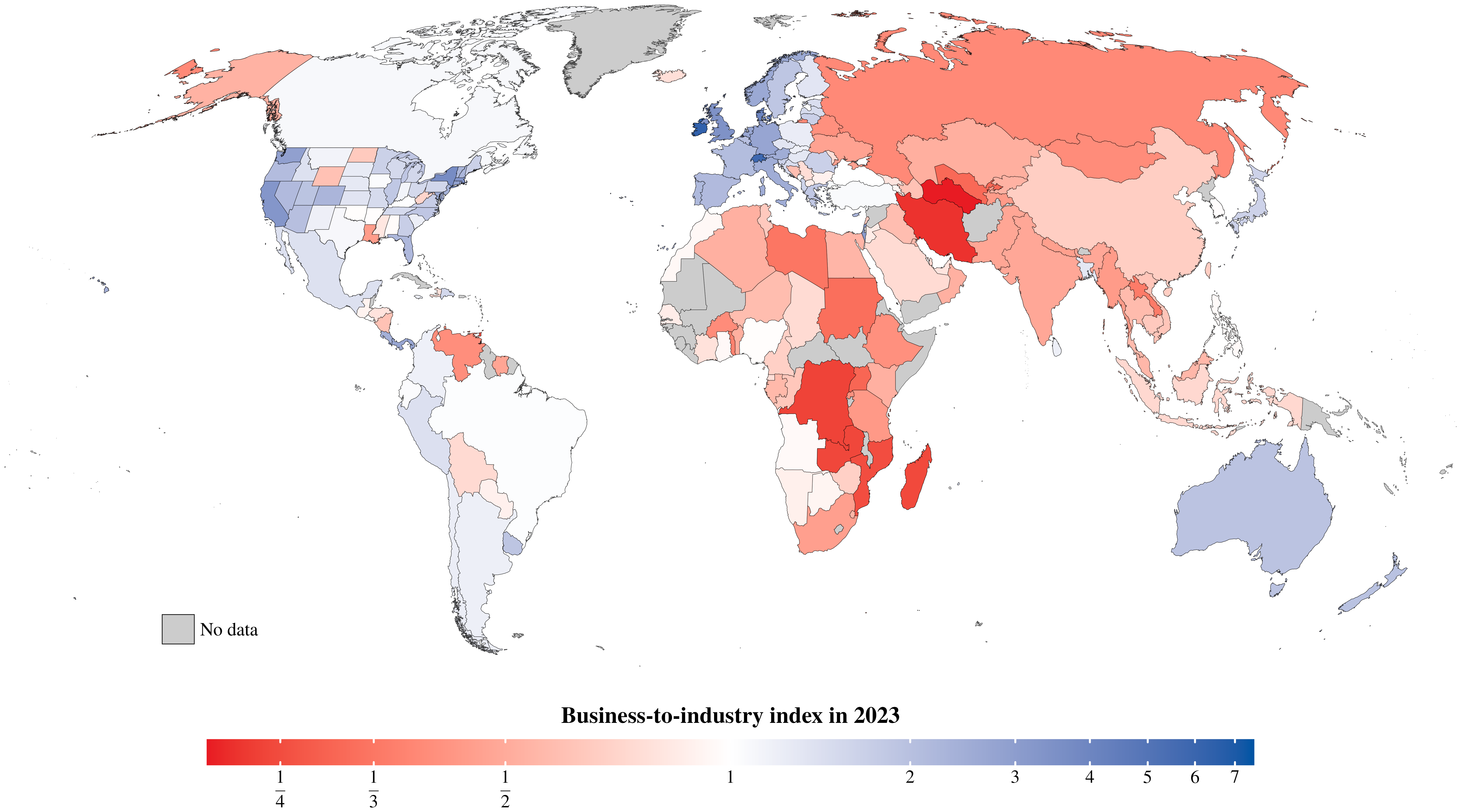
Viewed through this lens, the core of modern capitalism resides on the coasts of the United States, and in Western Europe. These regions command income that far surpasses what is warranted by their consumption of energy. In contrast, the rest of the world is industry dominated — it burns more energy than is warranted by its share of income.
Of course, there’s much more to be said about this data, but that will have to wait until my upcoming post, which will likely be out in early September. Until then, I’m off to the West Coast where I’ll be taking a break from work (both manual and intellectual).
Until next time
Well, that’s it for this update. As always, thanks for your support. Hope you’re keeping your head above the AI deluge. On that front, my colleague Erald Kolasi has written a timely piece about AI’s colossal energy consumption. He peg’s it at 1.1% of world energy use — an astonishing sum, giving AI’s dubious utility.
Best,
Blair